Every major pellet grill brand uses roughly the same core hardware — an auger to feed pellets, a hot rod ignitor to light them, an RTD probe to read temperature, and a controller board tying it together. That means most error codes across Traeger, Pit Boss, and Camp Chef trace back to one of the same handful of root causes, even though each brand displays and names them differently. This guide is a cross-brand quick reference: what each code or symptom actually means, and the fastest path to a fix. For a full deep dive on a specific brand or symptom, PitPrimer has dedicated guides linked throughout — this page is the map that tells you which one to open.
Affiliate disclosure: As an Amazon Associate, PitPrimer earns from qualifying purchases at no additional cost to you. Product features and pricing subject to change.
How Pellet Grill Error Systems Work, Briefly
Almost every error code on every brand maps to one of four subsystems:
- The RTD temperature probe — a sensor inside the cook chamber. When it reads too low, too high, or not at all, the controller shuts things down rather than guess.
- The auger and auger motor — feeds pellets from the hopper into the firepot. Jams, empty hoppers, or a failed motor all show up as heat-related errors even though the root cause is mechanical.
- The hot rod ignitor — heats up to light the pellets during startup. A failed or disconnected ignitor produces a failure-to-start error.
- Wi-Fi / app connectivity — a separate system from the above three, and rarely affects the actual cook, but throws its own class of errors on app-connected controllers.
Knowing which subsystem a code points to tells you where to physically look before you start swapping parts.
Traeger Error Codes at a Glance
| Code | Meaning | Most Common Cause |
|---|---|---|
| LEr / ErL | Low temperature error — grill shut down before reaching target | Empty or wet pellets, failed hot rod ignitor, fouled RTD probe |
| HEr / ErH | High temperature error | Grease fire in the firepot, or induction fan failure |
| Er1 | RTD probe reading fault | Dirty or disconnected temperature probe |
| Er3 / Er5 / Er6 / Er7 | Controller or wiring faults (varies by generation of controller) | Loose wiring harness, controller board issue |
| WiFire connectivity errors | App can’t reach the grill | Router/network issue, not a cook-safety issue |
Traeger’s error naming has changed somewhat across controller generations, so the exact on-screen text varies by model year. PitPrimer’s full Traeger Error Codes guide covers every current code with step-by-step fixes specific to WiFire and non-WiFire controllers.
Pit Boss Error Codes at a Glance
| Code | Meaning | Most Common Cause |
|---|---|---|
| Er1 / ErL | Poor connection to the RTD probe | Dirty probe, grease/ash buildup, damaged wiring |
| Er2 | Failed to reach 130°F minimum during startup | Empty hopper, un-primed auger, timed-out hot rod ignitor |
| ErH | Overtemperature | Too many pellets feeding at once, grease fire, soot-covered RTD probe giving a false reading |
| ErP | Startup priming issue | Auger not primed with pellets on first use or after running the hopper empty |
For a single-symptom deep dive on why a Pit Boss (or any brand) won’t reach temperature at all, see PitPrimer’s Why Is My Pellet Grill Not Heating Up? guide, which walks through the diagnostic order across all three brands.
Camp Chef Error Codes and Common Issues
Camp Chef’s Woodwind and Pursuit lines rely more on visual/manual diagnostics than a long numeric code list, but a few specific alerts and symptoms come up consistently:
| Issue | Likely Cause | Fix |
|---|---|---|
| PRERR (meat probe error) | Meat probe not fully seated in the controller port | Reseat the probe firmly; replace probe if the error persists with a known-good probe |
| Grill won’t ignite | Dirty firepot full of ash, damp or low-quality pellets, or a failed hot rod | Clean the firepot, switch pellets, hold a piece of paper near the hot rod to confirm it’s heating |
| Auger motor fan spins but auger doesn’t turn | Sheared auger pin (a deliberate weak point that protects the motor) | Replace the auger pin — an inexpensive, common fix |
| FLAME error / repeated flame-out | Low pellet quality, hopper running low, or firepot needs cleaning | Clean firepot and switch to a name-brand hardwood pellet |
Auger Jams: Cross-Brand Diagnosis and Fix
Auger jams are the single most common mechanical issue across all three brands, and the symptoms look identical regardless of manufacturer: the grill fails to reach temperature, you hear the auger motor straining or clicking without moving pellets, or nothing feeds at all.
- Turn off and unplug the grill. Never work on the auger with power connected.
- Empty the hopper and check for swollen or crumbled pellets — moisture is the most common jam cause, and pellets that have absorbed humidity swell and clog the auger tube.
- Check for a sheared auger pin (Camp Chef and some Pit Boss models use this as a sacrificial part) — if the motor’s small drive fan turns but the auger shaft doesn’t, the pin has done its job protecting the motor and just needs replacing.
- Clear visible obstructions with the hopper empty, then reprime the auger per your model’s manual before restarting.
Always store pellets in a sealed container rather than leaving a half-full bag in the hopper between cooks — humidity absorption is the root cause behind most auger jams on every brand.
Ignitor (Hot Rod) Failures: Cross-Brand Diagnosis and Fix
A hot rod ignitor that’s failed or disconnected produces a failure-to-start error on every brand, just under different code names (LEr on Traeger, Er2 on Pit Boss, a simple failure-to-ignite on Camp Chef). To test: remove the cooking grates and any heat baffle to expose the firepot, set the controller to start a cook, and hold a scrap of paper near the hot rod without touching it. If the rod isn’t glowing and the paper doesn’t singe within about a minute, the ignitor itself is the likely culprit rather than pellets or wiring. Hot rods are a wear item on every pellet grill and a straightforward owner-level replacement on most models.
Temperature Swings: Causes and Fixes
Wide temperature swings (more than about 20°F above or below your set point) usually come from one of these, roughly in order of likelihood:
- Cold or windy weather — the controller works harder to hold temperature and can overshoot on recovery. An insulated grill blanket meaningfully reduces this in winter.
- Dirty RTD probe — grease and ash buildup insulates the sensor and delays its reading, causing the controller to overcorrect.
- Grease buildup in the firepot — can cause brief flare-ups that spike temperature readings.
- Low-quality or inconsistent pellets — variable burn rates make the auger’s feed timing less predictable.
Wi-Fi and App Connectivity Issues
App connectivity problems are worth calling out separately because they’re frequently mistaken for cook-safety issues when they’re not — a grill that’s lost its Wi-Fi connection will typically keep cooking normally using its onboard controller; you just lose remote monitoring until the connection is restored. Common fixes: confirm the grill is within router range (metal grill bodies interfere with signal more than most appliances), restart both the grill’s controller and your router, and check for a firmware update in the manufacturer’s app, since outdated firmware is a frequent cause of dropped connections after a router change.
Hopper Fires: Prevention and What To Do
A hopper fire (pellets igniting inside the hopper itself, rather than the firepot) is rare but serious, and almost always traces back to a burn-back through the auger tube. Prevention matters more than reaction here:
- Never let the firepot overfill during a failed startup — if a grill fails to ignite twice, clear excess pellets from the firepot before trying a third time rather than letting them accumulate.
- Keep the auger tube and firepot area clean of grease and ash buildup, which can hold embers longer than they should.
- If a hopper fire does start: turn off and unplug the grill immediately, close the hopper lid to cut oxygen if it’s safe to do so, and keep a Class B or ABC fire extinguisher within reach any time the grill is running. Never use water on a grease or pellet fire.
PitPrimer’s White Smoke Troubleshooting guide covers the related issue of dirty or incomplete combustion, which is usually the warning sign before a firepot problem becomes a bigger one.
Replacement Parts Worth Keeping on Hand
For anyone running a pellet grill through a full season, a few spare parts turn an afternoon of troubleshooting into a 15-minute fix:
Hot rod ignitor — the most common failure point on any pellet grill after a year or two of regular use.
Find pellet grill hot rod ignitors on Amazon →

- 【Applicable Model】Replacement for REC-TEC/Recteq Wood Pellet Grill. Any Recteq purchased AFTER March 1, 2017, comes STANDARD wi…
- Hot flash ceramic igniter/ hot rod replacement kit fit for RECTEQ and rec tec wood pellet grill
- 【Package Include】1-Pack Ceramic Igniter Rod/Igniter with 1 Molex;
RTD temperature probe — inexpensive and often the real cause behind false high/low temperature errors.
Find RTD temperature probe replacements on Amazon →
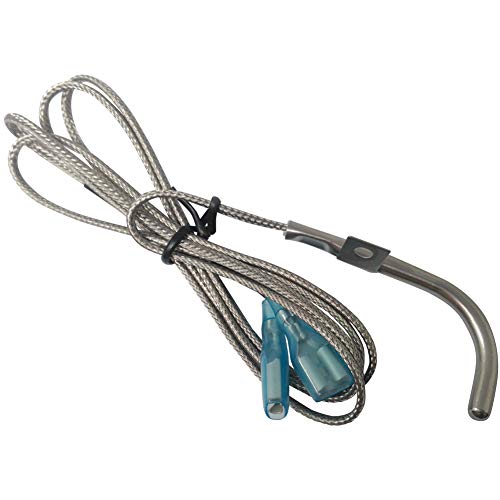
- Compatible with all Louisiana Grills Series and Country Smoker Series Model 50151
- 2″ Internal Grill Sensor Probe,41 3/4″ Stainless Steel Wire Lead,2Pcs female connectors
- The probe is 304 stainless steel, which has excellent processing performance, high toughness, and excellent high temperature an…
Auger motor — less frequently needed than the two parts above, but worth having on hand if your grill is out of warranty and the motor itself (not just the pin) has failed.
Find pellet grill auger motor replacements on Amazon →
![[2025 Upgraded] BlueStars 2.0RPM Grill Auger Motor Replacement Parts](https://m.media-amazon.com/images/I/51aM8GlWz0L._SL500_.jpg)
- 【Product Specifications】Rotating Speed: 2.0RPM | Voltage: 120V | Frequency: 60Hz | 2 Poles (ððððð ð ððð…
- 【Prevent Auger Clogging】This Auger Motor drives an auger screw which smoothly feeds wood pellets from the hopper into the fire…
- 【Superior Durability】BlueStars Grill Auger Motor ensures no cracking or stripping out for long-lasting performance. The fully-i…
When to Repair vs. Replace
Hot rods, RTD probes, and auger pins are all inexpensive, commonly available parts across every major brand — these are worth repairing on grills of any age. A failed controller board or a grill needing multiple simultaneous part replacements is a better moment to weigh repair cost against a new grill, particularly on entry-level models where a full controller board can run a meaningful fraction of the grill’s original price. For anyone shopping a replacement at that point, PitPrimer’s Pellet Smoker Starter Kit guide covers what’s actually worth buying for year one.
FAQ
Why does my pellet grill show a low-temperature error even though the hopper is full?
A full hopper doesn’t guarantee pellets are reaching the firepot. Check for an auger jam first (often caused by humidity-swollen pellets), then confirm the hot rod ignitor is actually heating, and finally check whether the RTD probe is clean enough to give an accurate reading.
Is it safe to keep cooking after a Wi-Fi disconnection error?
Generally yes — the onboard controller continues managing the cook independently of the app connection. You’ll lose remote temperature alerts until the connection is restored, so it’s worth checking in physically more often than you normally would.
How often should I replace the hot rod ignitor as routine maintenance?
There’s no fixed schedule; it depends on usage. Heavy users (multiple cooks per week) sometimes replace it preventively every 1–2 years, while occasional users can often run the original ignitor for several years. Testing it with the paper method above whenever a grill struggles to start is more useful than a calendar-based swap.
My grill worked fine last cook and now won’t ignite at all — where do I start?
Check pellets first (dampness or an empty hopper causes more failed starts than any hardware fault), then test the hot rod ignitor, then check for an auger jam. This order reflects how frequently each cause actually turns out to be the culprit.
Are error codes standardized across pellet grill brands?
No. Each manufacturer uses its own code naming, and even different controller generations from the same brand (like older vs. WiFire-enabled Traeger controllers) can display different codes for a similar underlying issue. The subsystem the error points to (probe, auger, ignitor, or connectivity) is the more useful thing to standardize your troubleshooting around.
Bottom Line
Most pellet grill problems, regardless of brand or the specific code on the display, trace back to one of four things: a dirty or failed RTD probe, an auger jam usually caused by pellet moisture, a worn-out hot rod ignitor, or a Wi-Fi connectivity issue that has nothing to do with the actual cook. Learn to check those four systems in order and you’ll resolve the large majority of errors without a service call. For the deepest coverage of a specific brand or specific symptom, PitPrimer’s dedicated guides on Traeger error codes, pellet grills not heating up, and white smoke problems go step by step through each fix.
Have a kamado instead? See our Kamado Joe troubleshooting guide — no error codes, just gaskets and airflow.