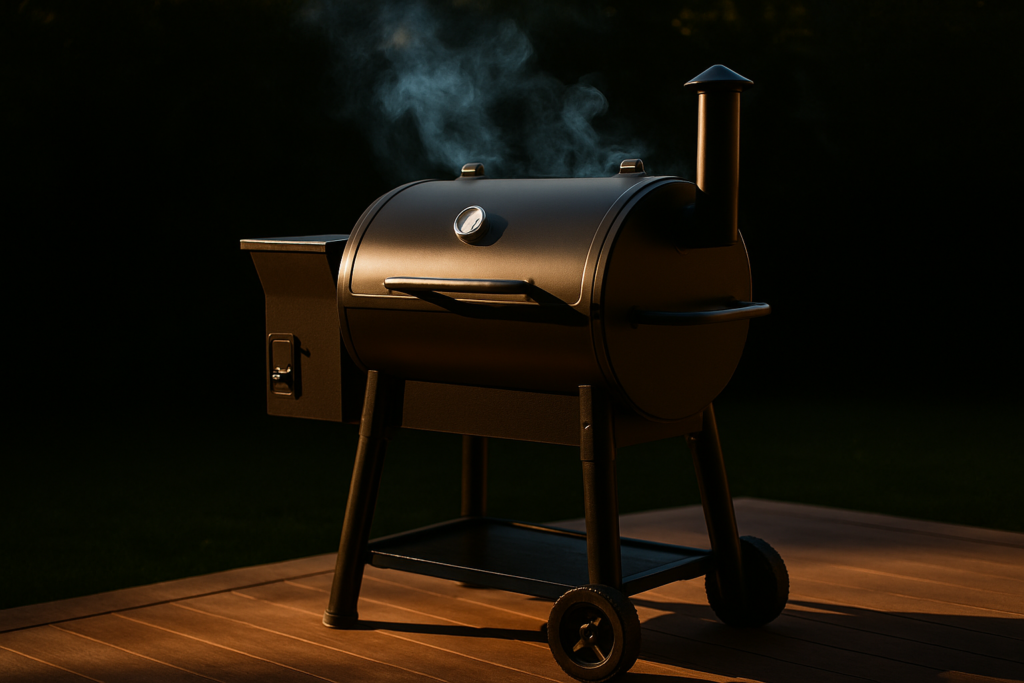
$500 is the price point where pellet grills stop being toys and start being genuinely capable smokers — steady temperature control, real cooking space, and hardware that holds up over multiple seasons. It’s also a price point with real trade-offs between brands, and the right pick depends more on what you’re optimizing for (cooking space, portability, or simplicity) than on any single “best” model. Here’s what’s actually worth buying right now.
Affiliate disclosure: As an Amazon Associate, PitPrimer earns from qualifying purchases at no additional cost to you. Product features and pricing subject to change.
What You Give Up (and Don’t) Under $500
Entry and mid-tier pellet grills in this range generally use simpler PID or basic digital controllers rather than the more advanced app ecosystems found on premium models, thinner-gauge steel bodies than $1,000+ grills, and smaller hoppers that need refilling more often on long cooks. What you don’t give up: accurate low-and-slow performance, WiFi/app control on several current models, and cooking space that’s genuinely sufficient for a family-sized brisket or a full rack of ribs. The step up from a $500 grill to a $1,000+ grill buys you thicker steel, larger hoppers, and often a more polished app experience — real upgrades, but not prerequisites for good barbecue.
It’s also worth separating brand reputation from build quality at this specific price tier. A $400 grill from a premium brand and a $400 grill from a value-focused brand are often closer in actual hardware than the name suggests — both are competing on the same components (auger, hot rod, RTD probe) at a similar cost basis. Where premium brands tend to differentiate at every price tier is app polish, customer support infrastructure, and resale value, not necessarily raw cooking performance.
Comparison Table: Best Pellet Grills Under $500
| Model | Typical Price | Cooking Space | Temp Range | Best For |
|---|---|---|---|---|
| Z Grills ZPG-450A | ~$340–$420 | 459 sq in | Up to ~450°F | Most cooking space per dollar |
| Pit Boss 500FB2 | ~$360–$400 | 518 sq in | 180–500°F | Small patios, largest grate in this tier |
| Camp Chef Pursuit 20 (PPG20) | ~$500 | 501 sq in | 160–500°F | Portability, folding legs for travel |
| Green Mountain Grills Davy Crockett | ~$330–$400 | 219 sq in | Up to ~450°F | Compact/tailgate, WiFi included standard |
Prices fluctuate with retailer promotions, so treat these as a starting range rather than a fixed number — check the current listing before buying.
Z Grills ZPG-450A — Best Value for Cooking Space
The ZPG-450A consistently lands at or near the bottom of this price tier while still offering 459 square inches of primary cooking space, a meat probe, and an 8-in-1 grill/smoke/bake/roast/braise/BBQ function set through its PID V3.0 controller. Z Grills doesn’t carry the brand recognition of Traeger or Pit Boss, but the company has built a loyal following specifically among budget-focused buyers who want dependable temperature holding without paying for a name. It’s a reasonable choice for someone who wants maximum square footage per dollar and doesn’t need app connectivity.
Check the Z Grills ZPG-450A on Amazon →

- ULTIMATE 8-IN-1– Barbecue wood fire pellet grill: bbq; bake; roast; braise; smoke; grill; sear; char-grill.
- PID V3.0 Smart Control– Features an upgraded PID controller that auto-tunes fuel and airflow, ensuring precise temperature con…
- Durable & Portable– Sturdy steel construction with a high-temperature powder coating finish makes the pellet grill long-lastin…
Pit Boss 500FB2 — Best for Small Patios
The 500FB2 offers the largest cooking surface in this comparison at 518 square inches, plus Pit Boss’s Flame Broiler lever for direct-flame searing — a feature usually reserved for larger, pricier models. Pit Boss also has the widest dealer and parts network of any brand in this list, which matters if you’d rather pick up a replacement hot rod or auger part locally than wait on shipping. The trade-off is a simpler LCD controller without WiFi on this specific model; Pit Boss reserves app connectivity for its higher-tier “Pro Series” and “Platinum” lines.
Check the Pit Boss 500FB2 on Amazon →

- 8-IN-1 COOKING VERSATILITY: Smoke, bake, braise, roast, grill, barbecue, chargrill, and sear all in one easy-to-use BBQ grill
- COMPACT SIZE, BIG FLAVOR: This smoker grill has 518 sq in of 2-tier, porcelain-coated, steel cooking space for family dinners a…
- MEAT PROBE MONITORING: Unlike other outdoor grills, this one has two probe ports with one probe included to help you track done…
Camp Chef Pursuit 20 — Best Portable Pick
The Pursuit 20 sits right at the $500 line depending on retailer, but it earns its spot by folding down with removable legs specifically for tailgating, camping, and truck-bed transport — a genuinely different use case than the other three grills here, which are built to stay in one spot on a patio. At 501 square inches it doesn’t sacrifice much cooking space for that portability, and Camp Chef’s ash cleanout system is one of the easier designs to maintain in this price tier. Choose this one specifically if the grill needs to travel; choose one of the others if it’s staying put.
Check the Camp Chef Pursuit 20 on Amazon →

- PID controller for consistent temperatures, Adjustable smoke settings from 1-10, 160º F – 500ºF temperature range
- Includes 2 meat probes
- Easy to use menu dial, High-visibility, low-glare digital display, Slide and Grill Technology’s direct flame grilling reaches 6…
Green Mountain Grills Davy Crockett — Best Compact/Off-Grid Option
The Davy Crockett trades cooking space for size and portability more aggressively than the Pursuit 20, at 219 square inches, and it’s built around a smaller footprint for camping, boating, or tight balconies rather than family-sized cooks. Its standout feature at this price is that WiFi control comes standard rather than as a premium add-on, plus an optional 12V/battery adapter for true off-grid use. Note that Green Mountain has been transitioning this line toward a newer “Trek” model, so availability of the original Davy Crockett may vary by the time you’re shopping — check current listings for whichever version is in stock.
Find the Green Mountain Grills Davy Crockett on Amazon →

- [Replacement] – GMG grill igniter replacement can replace model: GMG P-1021, P-1021,which is compatible with Green Mountain Dav…
- [Material]: The 12v ceramic hot rod igniter replacement is made of quality ceramic material, more faster to heat up and last lo…
- [Installation]:The installation of ceramic hot rod igniter is very simple, plug and play,which is located at the bottom of the…
What to Prioritize at This Price Tier
Cooking Space vs. Footprint
If you’re regularly cooking for more than 4–6 people or want room for a full brisket plus a rack of ribs at the same time, prioritize the 450–520 square inch models (Z Grills, Pit Boss, Camp Chef) over the compact Davy Crockett.
WiFi/App Control
Not every grill in this tier includes it. If remote temperature monitoring matters to you, the Davy Crockett includes it standard at this price point where the larger-format grills generally don’t.
Hopper Capacity
Larger hoppers mean fewer mid-cook refills on long smokes. This matters most for overnight brisket or pork shoulder cooks specifically, less so for shorter cooks like the chicken thighs and wings covered in PitPrimer’s poultry smoking guides. Most grills in this tier hold somewhere between 15 and 20 pounds of pellets, which is generally enough for a full 8–12 hour cook without a mid-smoke refill, though cold or windy weather increases pellet consumption and can shorten that window.
Parts Availability
Pit Boss and Camp Chef both have wider big-box retail presence than Z Grills or Green Mountain, which can matter if a hot rod or auger part fails mid-season and you’d rather not wait on shipping. See PitPrimer’s pellet grill troubleshooting guide for what typically fails first and how to keep spares on hand.
Gear to Pair With a Budget Pellet Grill
A grill in this tier performs closest to its full potential with a couple of inexpensive additions: a reliable instant-read thermometer (controller-integrated probes are convenient but slower and less precise than a dedicated instant-read for spot checks), and a wood pellet variety pack to figure out what pairs best with your usual proteins before committing to a full 40-lb bag of one flavor. PitPrimer’s Best Wood Pellets 2026 guide breaks down flavor pairing by wood type, and the Pellet Smoker Starter Kit guide covers everything else worth buying in year one without overspending on gear you won’t use.
FAQ
Can a pellet grill under $500 actually hold steady low-and-slow temperatures?
Yes. Temperature stability comes primarily from the controller and RTD probe quality, not the price tier, and all four grills above use PID or comparable digital controllers designed specifically for accurate low-and-slow holding. The main things you lose at this price are insulation thickness (which affects performance more in cold weather) and hopper size, not core temperature accuracy.
Is Z Grills a reliable brand even though it’s less well-known than Traeger or Pit Boss?
Z Grills has built a solid track record specifically in the budget segment over the past several years, with a large enough installed base that replacement parts and community troubleshooting resources are readily available. It’s a different value proposition than Traeger — Traeger leans on brand ecosystem and premium app features, Z Grills leans on maximizing cooking space per dollar.
Should I buy a smaller grill like the Davy Crockett as my only smoker?
Only if your typical cook size fits comfortably within roughly 200 square inches — a couple of racks of ribs or a single pork butt, for example. For anyone who regularly cooks for a full table or wants room to run multiple proteins at once, one of the larger-format grills in this list will fit real-world use better as a primary smoker.
Do any of these grills include a meat probe?
The Z Grills ZPG-450A and Pit Boss 500FB2 both include at least one integrated meat probe. Always verify current included accessories on the specific listing, since bundled extras change between retailers and over time.
What’s the biggest real difference between a $400 grill and a $1,000+ grill?
Primarily steel gauge and insulation (which affects performance in cold or windy conditions and pellet consumption rate), hopper size, and more advanced app features on premium controllers. Core cooking performance in moderate weather is closer between tiers than the price gap suggests.
Bottom Line
Under $500 is a genuinely capable price tier for pellet smoking rather than a compromise tier — the right choice comes down to matching the grill to how you’ll actually use it. Want maximum cooking space for the money: Z Grills ZPG-450A or Pit Boss 500FB2. Need it to travel: Camp Chef Pursuit 20. Cooking for one or two people or need something that fits in a truck bed or on a boat: Green Mountain Davy Crockett. Any of the four will produce real barbecue with the right technique behind it.