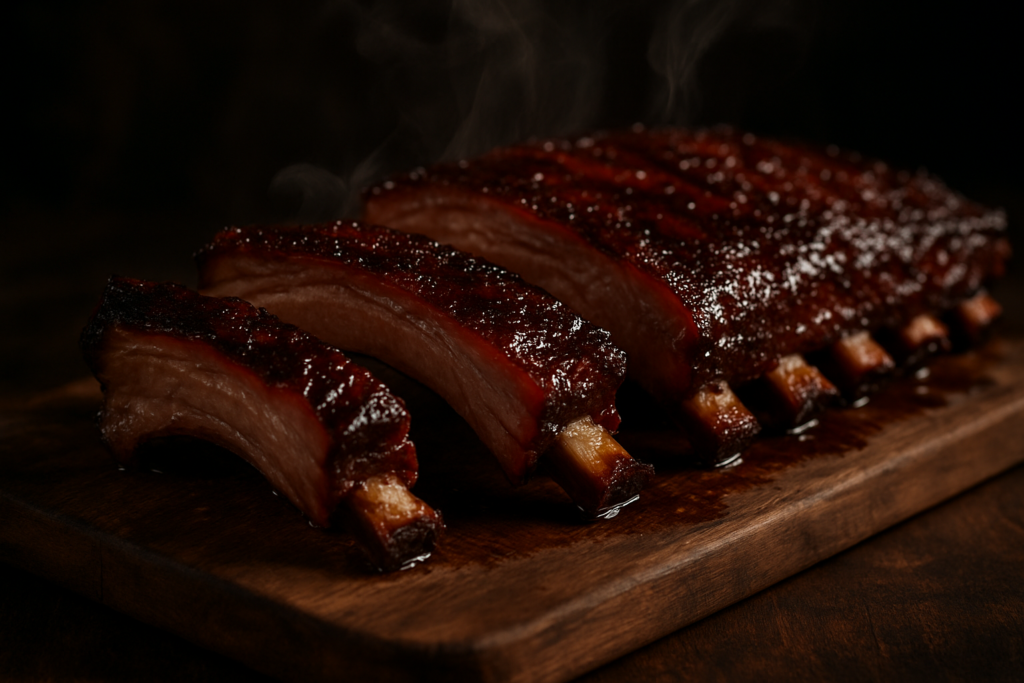
Ribs are the perfect first BBQ project.
Faster than brisket, more forgiving than pork butt, and universally loved. If you can smoke ribs, you can smoke anything else. This step-by-step guide walks through the entire cook — from picking the rack at Costco to the last rest before serving — with every temperature, timing, and checkpoint that separates good ribs from great ones.
In this guide (jump ahead)
- The very short version (3-2-1 method for spare ribs)
- Step 1: Choose your ribs
- Step 2: Prep the ribs
- Step 3: Smoke unwrapped at 225F for 3 hours
- Step 4: Wrap for 2 hours (the Texas crutch)
- Step 5: Unwrap and glaze for 1 hour
- Step 6: The tests for doneness
- Step 7: Rest, then serve
- Common first-timer mistakes to avoid
- Timing example: dinner at 6 pm on Saturday
- What to serve with ribs
- Related guides
- Editor’s ranking
- Related PitPrimer guides
Disclosure: PitPrimer earns commission on qualifying purchases through Amazon Associates.
Video: Malcom Reed’s Ribs, via YouTube.
The very short version (3-2-1 method for spare ribs)
- Smoke unwrapped at 225F for 3 hours.
- Wrap in foil with butter, brown sugar, honey, and apple juice. Return to smoker for 2 hours.
- Unwrap, brush with glaze/sauce. Smoke unwrapped for 1 hour.
- Rest 10-15 minutes, slice, serve.
Total cook time: 6 hours. Total active time: about 20 minutes.
For baby back ribs, use 2-2-1 (they cook faster). For St. Louis-cut spare ribs, use full 3-2-1.
Step 1: Choose your ribs
Three main styles:
See also: How to Smoke Pork Shoulder for Pulled Pork: The Complete First-Timer Guide
- Baby back ribs – from the upper part of the pig ribcage. Shorter, leaner, more tender. Cost per pound is highest. Cook time 4-5 hours.
- Spare ribs – from the belly section, includes the tips and cartilage. Meatier, more forgiving of slight overcooks. Cost per pound is lowest. Cook time 6 hours.
- St. Louis cut – spare ribs with the tips and cartilage trimmed off to make a rectangular rack. Cleaner presentation, more consistent cook. Cook time 6 hours.
For your first cook: St. Louis-cut spare ribs. Best balance of forgiveness, flavor, and manageable size.
Where to buy: Costco whole spare rib packs are the best value. Local butcher for higher-grade racks. Grocery store as fallback.
Step 2: Prep the ribs
Remove the silverskin membrane
The membrane on the bone side of the ribs blocks smoke penetration and gets rubbery when cooked. Remove it before cooking. Slide a butter knife under the membrane at one corner, grip with a paper towel, pull. It comes off in one sheet if you get lucky.
If the membrane keeps tearing into pieces instead of coming off clean, a dedicated rib membrane removal tool set gives more grip than a butter knife and paper towel alone — a small, cheap fix for a genuinely annoying step.
Trim excess fat
Leave a thin fat cap (~1/8 inch). Remove big lumps of hard fat that will not render.
Rub
Two-part rub philosophy: salt and pepper are non-negotiable base. Everything else is flavoring.
Simple St. Louis-style rub:
- 2 tbsp kosher salt
- 2 tbsp coarse black pepper
- 2 tbsp brown sugar
- 1 tbsp paprika
- 1 tbsp garlic powder
- 1 tsp cayenne (optional)
Apply generously to both sides of the ribs. Let sit 30 minutes to 2 hours at room temp before smoking.
- Meat Church Honey Hog (ready-made rub)
- Meat Church BBQ Rub Combo: Honey Hog (14 oz) and Holy Gospel (14 oz) BBQ Rub and Seasoning for Meat and Vegetables, Gluten Free…
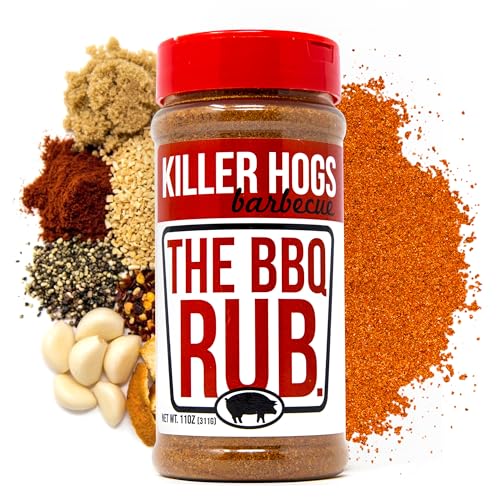
- Killer Hogs The BBQ Rub
- CHAMPIONSHIP PITMASTER FLAVOR: Created by the Killer Hogs Championship BBQ team, this legendary Killer Hogs BBQ Rub delivers a…
- BALANCED SWEET HEAT FLAVOR: A blend of brown sugar, paprika, and spices delivers the classic sweet BBQ rub flavor pitmasters lo…
- MADE FOR BBQ: Crafted to bring out bold flavor and beautiful bark, this savory beef rub enhances steaks, hamburgers, and grille…
- Coarse black pepper (16 oz)
- Kosher salt (Diamond Crystal)
- No additives; Only pure kosher salt
- Diamond Crystal Kosher Salt is endorsed by the American Culinary Federation
- Pure and Natural with no GMOs


Step 3: Smoke unwrapped at 225F for 3 hours
Set smoker to 225F. Choose wood: apple, cherry, or hickory. Apple is the classic pork smoking wood – mild sweet smoke that does not overpower.
See also: Traeger vs Recteq 2026: The Enthusiast Pellet Grill Head-to-Head (Which Ranks Higher?)
Place ribs bone-side down on the smoker. Insert a wireless meat thermometer probe into the thickest part of the meat (not touching bone).
Smoke undisturbed for 3 hours. Do not open the smoker to check. The temperature should climb to about 165-170F internal.
The bark should be a rich mahogany color by the end of this phase.
See our Best Meat Thermometer 2026 guide for probe picks.
Step 4: Wrap for 2 hours (the Texas crutch)
Lay out a large sheet of heavy-duty aluminum foil. Add:
See also: Best Meat Thermometer for BBQ 2026: ThermoWorks, MEATER, BBQOVN, and Inkbird Head-to-Head
- 2 tbsp butter (sliced into pats)
- 2 tbsp brown sugar
- 1 tbsp honey
- Splash of apple juice or apple cider vinegar
Place ribs meat-side down on top of the mixture. Wrap tightly. Return to smoker for 2 hours.
What is happening: the ribs are steaming in their own juices plus the sugars. Bark softens slightly but tenderness accelerates dramatically. Internal temperature climbs from 170F to 195-200F.
- Heavy-duty foil (18″ commercial)
- ðððð¯ð² ðð®ðð² ðð¥ð®ð¦ð¢ð§ð®ð¦ ð ð¨ð¢ð¥: Made from excellent quality, this foil…
- ð ð¨ð¨ð ðð«ðð©ðð«ððð¢ð¨ð§ ðð§ð ððð¨ð«ðð ð: Exceptional Foil For A…
- ðð¨ð¨ð ðð§ð¨ð®ð ð¡ ðð¨ð« ðð§ðð®ð¬ðð«ð¢ðð¥ ðð¬ð: This Item Was Pro…
- Pink butcher paper (alternative to foil)
- Enhance your smoking meat adventure with our 24-inch wide roll of butcher paper specially crafted to entrap the flavorful smoke…
- Experience the unique properties of our 24 wax paper, an exclusive feature of our peach butcher paper smoking meat. Its reinfor…
- Our butcher paper wide roll comes as an easy-to-use paper roll, ensuring peach butcher paper smoking meat is a straightforward…


Step 5: Unwrap and glaze for 1 hour
Unwrap the ribs. Return to smoker meat-side up. Brush with your glaze of choice:
- BBQ sauce (thinned with apple juice if too thick)
- Honey + soy + garlic
- Peach preserves + apple cider vinegar
Smoke unwrapped for 1 hour. Brush with additional glaze every 20 minutes. The glaze tightens and glosses.
Target internal temperature at the end: 200-205F. But temperature alone is not the test – see next step.
Step 6: The tests for doneness
The bend test
Pick up the rack with tongs from one end. It should bend downward at a 90-degree angle. Cracks may appear on the surface between the bones. If the rack stays rigid, cook longer.
The toothpick test
Slide a toothpick between two bones through the meat. It should feel like sliding through warm butter – no resistance. If it feels like poking cardboard, cook longer.
The pull-back
Meat should have pulled back from the ends of the bones by about 1/4 inch, exposing the ends.
When all three signs align, the ribs are done.
Step 7: Rest, then serve
Rest ribs 10-15 minutes wrapped in foil (or under a towel) before slicing. This lets juices redistribute.
Slice between the bones with a sharp knife. Serve immediately with sides.
Common first-timer mistakes to avoid
- Not removing the silverskin membrane. Skipping this step leaves you with rubbery mouthfeel on the bone side.
- Cooking too hot. Above 275F, ribs dry out. Stay at 225-250F.
- Opening the smoker constantly to check. Every peek adds 15-20 minutes and drops temperature 25-50F. Trust your wireless probes.
- Skipping the wrap phase. The wrap is what accelerates tenderness. Without it, spare ribs take 8-10 hours to reach tender.
- Confusing “fall-off-the-bone” with “properly done.” Fall-off-the-bone is overcooked. Properly done means meat pulls cleanly with a slight bite – you should be able to lift a rib by the bone and take a bite.
- Not resting before slicing. Skipping the 10-15 min rest loses juices.
Timing example: dinner at 6 pm on Saturday
- Friday night: prep rub, remove membrane, apply rub, refrigerate overnight.
- Saturday 11 am: fire smoker to 225F.
- Saturday 11:30 am: ribs on the smoker.
- Saturday 2:30 pm: wrap in foil with butter/brown sugar/honey.
- Saturday 4:30 pm: unwrap, glaze, return to smoker.
- Saturday 5:30 pm: check bend + toothpick tests. Continue if needed.
- Saturday 5:45 pm: rest 10-15 minutes.
- Saturday 6 pm: slice and serve.
What to serve with ribs
- Coleslaw
- Baked beans (bonus points for cooking them under the ribs on the smoker to catch drippings)
- Mac and cheese
- Cornbread
- Pickles and raw white onion (traditional Texas plate)
- Potato salad
Related guides
- How to Smoke Brisket: First-Timer Guide
- Best Pellet Smoker 2026
- Best Wood Pellets 2026 (apple/cherry/hickory for pork)
Editor’s ranking
3-2-1 for St. Louis-cut spare ribs. 2-2-1 for baby backs. Apple or cherry wood. 225F. Trust your thermometer. Trust the bend test. Rest before slicing.
Your first rack will not be perfect. Your fifth rack will make you the neighborhood’s BBQ authority.
About this guide
Our recommendations synthesize manufacturer specifications, published editorial reviews (AmazingRibs, Wirecutter, Serious Eats, Meathead), and community feedback from BBQ forums (r/smoking, r/BBQ, Smoking Meat Forums), cross-checked against real-world reports. We do not accept payment for recommendations.
Last reviewed: July 2026
Related PitPrimer guides
- How to Smoke Brisket for First-Timers: A Step-by-Step Guide That Actually Works
- How to Smoke Pork Shoulder for Pulled Pork: The Complete First-Timer Guide
- How to Smoke a Whole Turkey for Thanksgiving 2026: Complete Method + Gear Guide
- Best Kamado Joe Accessories 2026: DoJoe, Cast Iron, JoeTisserie, Cold Smoke, and Maintenance
Frequently asked questions
How were these products selected?
This guide is a research-based synthesis of product specs, brand reputation, current Amazon reviews, and category trends. It is not a hands-on review – use it to narrow options before you buy.
What price range should I expect?
Prices vary significantly across the categories above. Entry options start at the lower end of each tier listed, while premium picks can be several times more. Amazon pricing changes frequently, so confirm current numbers on the product listings.
Should I always buy the most expensive option?
Not necessarily. Premium products offer better materials, longer warranties, and higher-end features, but mid-tier picks meet the needs of most buyers. Match the pick to your actual use case rather than defaulting to the top of the price range.
How often is this guide updated?
This guide is refreshed as new products launch and older picks are discontinued. Amazon pricing and stock change daily – always confirm current price and availability on Amazon before purchase.
Where is the best place to buy?
Amazon is linked throughout this guide because it typically has broad selection, current pricing, and standardized return policies. Direct manufacturer sites and specialty retailers are also options depending on category and preference.
Shop the Amazon Storefront
Every pellet smoker, grill, and BBQ accessory recommendation – curated in one Amazon Storefront.
Try Amazon Prime free for 30 days – fast pellet and BBQ ingredient delivery
As an Amazon Associate and Amazon Influencer, we earn from qualifying purchases at no extra cost to you.