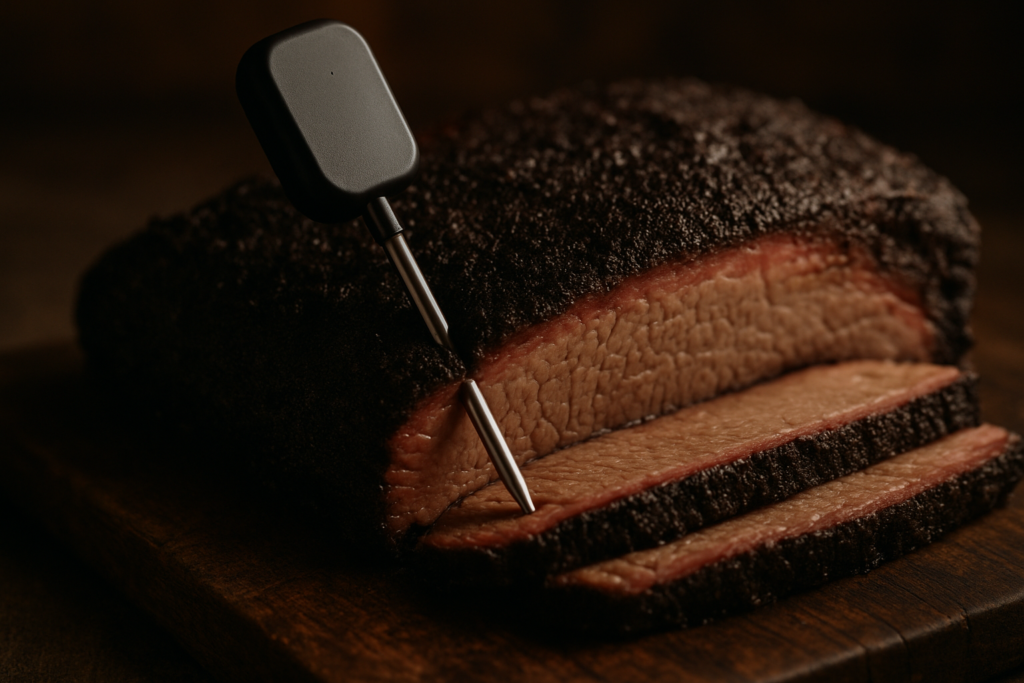
The instant-read is for spot checks. The WiFi wireless is for a nap on the couch.
A WiFi meat thermometer lets you leave the house during an 8-hour brisket cook and get a push notification when it hits internal target. This guide covers the WiFi-connected wireless meat thermometers that actually work reliably in 2026, ranked by probe count, range, and app quality — MEATER, FireBoard, Thermoworks Signals, BBQOVN, and Inkbird.
In this guide (jump ahead)
Disclosure: PitPrimer earns commission on qualifying purchases through Amazon Associates. Rankings reflect editorial synthesis of manufacturer specs, owner reviews, and category expertise.
Wireless vs cabled probes: the tradeoff
- Wireless probe (MEATER, Combustion Predictive) — the probe itself is the sensor. Insert once, close the grill, no cable to route. Range 30-165 ft direct; some models use a WiFi bridge for longer. Battery in the probe. Convenient but harder to add a second probe cheaply.
- Cabled probe with wireless base (FireBoard 2, Thermoworks Signals, BBQOVN, Inkbird) — probe wires run from meat to a base station that sits by the grill. Base transmits over WiFi to phone. Cheaper per probe, easier to run 4-6 probes at once, requires cable management.
Fastest way to pick
- Best wireless (no cable) ~$100-140: MEATER 2 Plus or MEATER Block. Single-probe simplicity, WiFi app, no cable to manage.
- Best multi-probe premium ~$200-350: FireBoard 2 Drive or Thermoworks Signals. Six channels, competition-grade accuracy, cloud app, fan-control auto-cooking optional.
- Best mid-range 4-probe ~$60-90: BBQOVN BBQ9 or Inkbird IBBQ-4T. Four probes, WiFi + Bluetooth, solid app. Best value in the space.
- Best budget WiFi ~$40-60: Inkbird IBBQ-4BW or ThermoPro TP-90S. WiFi + Bluetooth, decent app, no fan control. Fine for a first thermometer.
- Best predictive AI ~$150-200: Combustion Predictive Thermometer. Eight sensors in one probe predict “done in X minutes” like the MEATER but with more accuracy.
The specs that actually matter
- Probe count — one is enough for a whole brisket. Four is the sweet spot for a rack of ribs + pit temp + second protein + backup. Six is a competition rig. Wireless-probe designs are expensive to add more of; cabled bases scale cheaply.
- Range and connectivity — direct Bluetooth range is 30-165 ft depending on model. WiFi via base station is basically unlimited (get the notification from the grocery store). Cloud app quality varies wildly — FireBoard and Thermoworks are pro-tier; some budget apps go offline for hours randomly.
- Accuracy — competition-grade thermometers are +/- 1.8F. Budget wireless is +/- 5-8F. For most BBQ, +/- 5F is fine; brisket temps within 200-205F are all “done.” For sous vide or thin steaks, tighter accuracy matters more.
- Max probe temperature — most probes rated 500-572F. Some MEATER models max at 527F. Cabled probes with thin cables can melt if run through a hot grill lid seam. Check the rating vs your typical cook temp.
- Battery life — MEATER 2 Plus: 24+ hrs per charge. FireBoard 2: rechargeable 30+ hrs. Base station probes usually powered by AA or USB. Nobody wants a dead thermometer at hour 9 of a brisket cook.
- App quality — can it push notifications reliably? Log temp graphs? Share to a friend during a group cook? Integrate with fan controllers? App quality often determines whether the device gets used long-term.
Best wireless meat thermometer by category
Best wireless (no cable): MEATER 2 Plus and MEATER Block
The MEATER format is a probe you insert into the meat and forget. No cable dangles from the grill lid. WiFi via a base station gives essentially unlimited range. App shows internal + ambient temp and predicts “estimated time to done.”
MEATER 2 Plus (about $130) is the single-probe latest gen with rechargeable USB-C base. MEATER Block (around $300) is four probes with a screen and wooden bamboo charger. Both are competition-viable for accuracy. Where they rank lower: adding more probes = buying more MEATERs at about $130 each. Cabled multi-probe systems are cheaper per channel.
- MEATER 2 Plus (single probe)
- Truly Wireless Design: 100% wire-free, the MEATER Plus offers complete flexibility and freedom in your cooking.
- Freedom to Cook Anywhere: With a built-in Bluetooth repeater in the charger, MEATER Plus extends wireless range, allowing you t…
- Dual Sensor Accuracy: the probe is equipped with dual temperature sensors, and monitors both internal meat temperature (up to 2…
- MEATER Block (4 probes)
- Multi-Meal Mastery: With four probes, cook multiple proteins to everyone’s preferred doneness—whether it’s steak cooked medium-…
- Enhanced Connectivity: Built-in WiFi extends range, allowing you to monitor your cook from anywhere. No need to hover – monitor…
- Rapid Charging: USB-C fast charging ensures you’re ready to cook with minimal downtime. Get 24 hours of continuous cooking time…
- MEATER Plus (previous gen)
- Chef in your Pocket: Achieve perfect results with Smart Temp Multisensor technology and master any protein and any cooking meth…
- Cook and Monitor Anything: Nail every cook from start to finish from grilling, smoking, roasting, deep frying, direct heat, sou…
- 100% Wireless: Say goodbye to tangled wires and limited mobility. The MEATER Pro is completely wireless, allowing you to monito…


Best multi-probe premium: FireBoard 2 Drive and Thermoworks Signals
Competition-tier. FireBoard 2 Drive (around $250) offers six probe channels, WiFi + Bluetooth, cloud app with graphing, and optional fan controller integration for automatic temperature holding. Thermoworks Signals (about $230) is the four-channel equivalent with Thermoworks’ well-known accuracy and durability. Both are used at competition BBQ contests.
What you pay for at this tier: 5-year probe warranty, cloud app that never drops, actual multi-user sharing, and fan controller optionality. Overkill for a Saturday burger cook. Right for a serious BBQ hobbyist or aspiring competitor.
- FireBoard 2 Drive (6 channels)
- Smart Display Base: Unlike other thermometers that require an app to function, the P2’s smart base provides direct target tempe…
- Unlimited Range via Wi-Fi: Unlike Bluetooth-only thermometer, the ThermoMaven P2 uses 2.4GHz Wi-Fi to connect the base to your…
- 100% Wireless Freedom: Kiss tangled wires goodbye with the ThermoMaven P2. Roam freely with Bluetooth long-range connectivity,…
- Thermoworks Signals (4 channels)
- ð¥Recommended leave-in thermometer by America’s Test Kitchen.
- Trusted by Chefs Worldwide: DOT is used by top chefs and BBQ champions, preferred for its reliability and performance.
- Simple One-Touch Operation: Set your target temperature with just two buttons — no complicated setup required.
- FireBoard Spark (instant read tier)

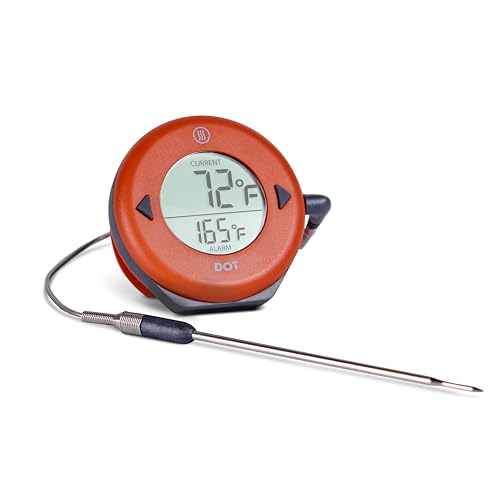
Best mid-range 4-probe: BBQOVN BBQ9 and Inkbird IBBQ-4T
The value sweet spot. Four probes, WiFi + Bluetooth, decent apps, $60-90. BBQOVN BBQ9 has a small screen on the base station and a rechargeable battery. Inkbird IBBQ-4T is longer-established with a more mature app and larger user base for troubleshooting. Both hit +/- 3F accuracy and 165+ ft range.
Where they rank below premium: apps occasionally have cloud outages, no fan controller integration, probes have 1-year warranty vs 5 for FireBoard. For 90% of home BBQ cooks, these are the right pick.
- BBQOVN BBQ9 (4-probe)
- BBQOVN Smart Wireless Meat Thermometer,WiFi Unlimited Range Sub-1G (10X Stronger Than Bluetooth) 7 NIST-Certified Sensors ±0.5°…
- Built-In Display Base for Quick Checks: Check your food’s temperature at a glance without reaching for your phone. The smart ba…
- Reliable Wireless Monitoring Around Your Home: The probes connect to the smart base, allowing you to move freely while keeping…
- Inkbird IBBQ-4T
- 3 Combination Mode of Wifi/Bluetooth/Non-Phone Connect 4 Probes Wirelss Meat thermoemter. No range limited when use 2.4Ghz wifi…
- 4 Probes Digital Food Cooking Meat Thermometer with 2.24*4 Inches Full-viewing Angle Backlit LCD Screen.The unit can save 30 mi…
- Precise Temperature Control of Remote Range Food Thermometer with ±1℃/±1.8℉ Accuracy and -12.6℉~+12.6℉ Calibation.Each probe is…
- Inkbird IBT-6XS (6-probe)
- Note: Only suitable for IBT-4XS and IBT-6XS thermometers, not suitable for other thermometers, otherwise it will inaccurate mea…
- 3 Meat Probes and 1 Ambient Probe for Bluetooth Meat Thermometer IBT-4XS and IBT-6XS: 3 replacement meat probes (red, yellow an…
- Temperature Range & Accuracy for Grill thermometer Probe: The BBQ thermometer probes temperature range is 32° F ~ 572 ° F/0C°-3…


Best budget WiFi: Inkbird IBBQ-4BW and ThermoPro TP-90S
Under $60 for a WiFi-enabled thermometer with 4 probes. Inkbird IBBQ-4BW (about $50) has the same probe count as the -4T but simpler base station. ThermoPro TP-90S (around $45) is a common entry-level pick with basic app functionality. Both are fine for a first-time wireless thermometer purchase.
Where they rank lower: apps are simpler, probes 1-year warranty, accuracy +/- 5F. Any long enough cook where accuracy really matters, step up a tier.
- Inkbird IBBQ-4BW
- 【The Ultra Fast Food Thermometer responds in 3-5 Seconds】And the instant read smoker meat thermometer supports lock readouts wh…
- 【Wireless WiFi Control & Easy APP & Wide Temperature Range】This WiFi Meat Thermometer is required to connect 2.4GHZ WiFi, downl…
- ThermoPro TP-90S
- 【Make sure fit your model number】Work with Thermopro TP20 TP25 TP-08 TP27 TP930 TP829 TP28 TP08 TP17 TP-16 TP910 TP07 TP17H TP0…
- 【Humanized design to meet demand】The lightweight ambient probe can measure the temperature of the oven or Grill, allowing you t…
- 【Stable and durable as always】Using the latest imported thermistor make the sensitivity reach within 1 ℃, the accuracy is kept…
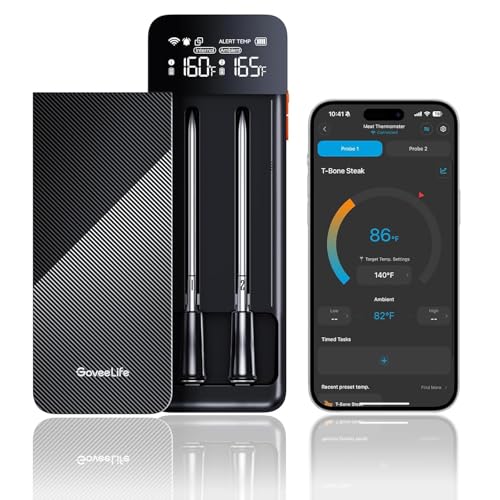
- Govee WiFi Thermometer (basic tier)
- Smart Display Base: This digital meat thermometer features a 10-function LCD screen with live temperature tracking. The probe f…
- Reliable Dual-Band Connection: Our wireless meat thermometer delivers rock-solid remote monitoring through both 2.4g WiFi and B…
- Professional-Grade Sensors: Engineered with dual internal/external probes, this digital meat thermometer achieves ±1.8°F precis…

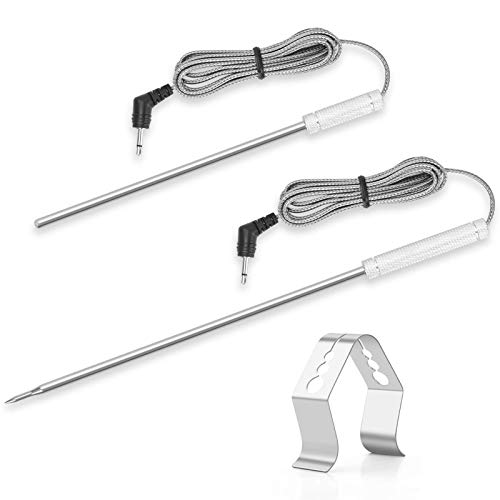
Best predictive AI: Combustion Predictive Thermometer
The newer entrant. Eight temperature sensors along the length of a single wireless probe. Uses the multi-point data to predict “done in X minutes” more accurately than a two-sensor MEATER can. $150-200. Rechargeable USB-C base. WiFi via included display station. Cloud app.
Where it wins: the prediction is genuinely better than MEATER for briskets and pork shoulders because it detects the stall vs approach curve. Where it ranks lower: single probe only, and the Combustion app ecosystem is smaller than MEATER’s. If you cook one big cut at a time, this is worth considering over the MEATER 2 Plus.
- Combustion Predictive Thermometer
- Live Temperature Monitoring: Stay updated with real-time readings
- Robust Heat Safeguard: Protect your food from excessive heat
- Multi-Task Tracking: Monitor multiple aspects simultaneously
- Combustion Display + Charger
- 20000mAh Large Capacity: This 35W fast charging power bank has a large capacity of 20000mAh, which can power your devices multi…
- 35W Fast Charging Power Bank: This 35W external battery power bank delivers rapid charging for your devices, capable of chargin…
- Two-way Fast Charging: This external battery power bank has a two-way fast charging function, with two charging methods of 35W…

Common mistakes to avoid
- Trusting the built-in probe on your pellet grill. Nearly every built-in probe reads 10-20F off. Add a proper wireless thermometer and calibrate.
- Placing the probe wrong. In brisket: thickest part of the flat, not the point (which cooks faster). In pork shoulder: away from bone. In chicken: thickest part of thigh, not touching bone. Probe placement matters more than probe brand.
- Running a probe cable through a hot lid seam. Cheap cables melt at 400F+ if they touch the metal. Route around the lid gasket, not through it.
- Skipping the ambient probe. Grate-level ambient temp is often 20-40F off the dome thermometer reading. Real BBQ is cooked to grate temp, not dome temp.
- Buying too many probes for how you actually cook. Most home cooks use 2 probes (meat + ambient) 90% of the time. Six-channel systems are overkill until you are running multi-protein competition cooks.
- Ignoring app quality. A thermometer with a mediocre app never gets used long-term. Read app reviews before buying.
Frequently asked questions
Do I need WiFi or is Bluetooth enough?
Bluetooth range is 30-165 ft direct. If you cook and stay at the grill, Bluetooth is fine. If you want to leave the house or go to bed while a brisket runs overnight, WiFi is the answer.
MEATER vs a cabled multi-probe: which is better?
MEATER is better if you cook single big cuts and hate cable management. Cabled multi-probe is better if you run multiple proteins simultaneously, want the pit-temp ambient probe, or need six channels for a competition-style cook.
How accurate does a BBQ thermometer need to be?
+/- 5F is fine for BBQ (brisket done at 200F vs 205F tastes identical). +/- 2F matters for steaks and sous vide (medium-rare and medium are 5F apart).
Are the “predict when done” features accurate?
MEATER prediction: usually within 30 minutes of actual. Combustion prediction: usually within 15 minutes. Neither is exact because stalls happen unpredictably, but both are useful for planning dinner timing.
Can I use a wireless thermometer inside my oven or sous vide?
Most probes are rated 500-572F oven-safe. MEATER 2 Plus and Combustion are oven-safe. Sous vide submersion depends on model — check IP rating before dropping a probe in water.
Bottom line
The right wireless meat thermometer depends on how you cook. Single big cut, no cable = MEATER 2 Plus. Multi-probe competition = FireBoard 2 Drive or Thermoworks Signals. Mid-range 4-probe value = BBQOVN BBQ9 or Inkbird IBBQ-4T. Budget WiFi entry = Inkbird IBBQ-4BW or ThermoPro TP-90S. Predictive AI single probe = Combustion. Match the format to how you actually cook and the app becomes something you actually use.
See also: Traeger vs Recteq 2026: The Enthusiast Pellet Grill Head-to-Head (Which Ranks Higher?)
More BBQ and grilling picks: PitPrimer covers pellet smokers, gas grills, griddles, and accessories with a focus on ranked comparisons rather than one-brand cheerleading. Bookmark the home page for the latest guides.
Related PitPrimer guides
- Best Meat Thermometer for BBQ 2026: ThermoWorks, MEATER, BBQOVN, and Inkbird Head-to-Head
- Best Instant-Read Meat Thermometer 2026: Thermapen One, Lavatools Javelin Pro, and ThermoPro Ranked
- Best BBQ Setup Under $500 Complete Guide 2026: Grill + Thermometer + Tools + Fuel + First-Cook
- Best BBQ Meat Injector 2026: SpitJack, Grill Beast, and Marinade Tools Ranked
Frequently asked questions
How were these products selected?
This guide is a research-based synthesis of product specs, brand reputation, current Amazon reviews, and category trends. It is not a hands-on review – use it to narrow options before you buy.
What price range should I expect?
Prices vary significantly across the categories above. Entry options start at the lower end of each tier listed, while premium picks can be several times more. Amazon pricing changes frequently, so confirm current numbers on the product listings.
Should I always buy the most expensive option?
Not necessarily. Premium products offer better materials, longer warranties, and higher-end features, but mid-tier picks meet the needs of most buyers. Match the pick to your actual use case rather than defaulting to the top of the price range.
How often is this guide updated?
This guide is refreshed as new products launch and older picks are discontinued. Amazon pricing and stock change daily – always confirm current price and availability on Amazon before purchase.
Where is the best place to buy?
Amazon is linked throughout this guide because it typically has broad selection, current pricing, and standardized return policies. Direct manufacturer sites and specialty retailers are also options depending on category and preference.
Shop the Amazon Storefront
Every pellet smoker, grill, and BBQ accessory recommendation – curated in one Amazon Storefront.
Try Amazon Prime free for 30 days – fast pellet and BBQ ingredient delivery
As an Amazon Associate and Amazon Influencer, we earn from qualifying purchases at no extra cost to you.