
Affiliate disclosure: As an Amazon Associate, PitPrimer earns from qualifying purchases at no additional cost to you. Product availability subject to change.
How we picked: we compared current Amazon listing details and manufacturer specifications. We have not used these products ourselves. Our research and recommendation methodology explains how picks are made.
Safety note: Torches produce an open flame and very hot nozzles. Follow the torch and fuel maker’s instructions, use propane torches outdoors or in a well-ventilated area away from flammables and other gas tanks, leak-check fittings, and let the nozzle cool before storing it. Grills, charcoal and smokers are for outdoor use only. Check doneness with a thermometer: USDA FSIS lists steaks at 145°F with a 3-minute rest, ground beef at 160°F and poultry at 165°F.
For searing sous vide steak, a propane torch gun with an adjustable flame and a trigger lock, such as the Kimmzii or TAUSOM, is the most direct pick: both run on standard 1-lb propane cylinders and list a high-heat jet for crust plus a low setting for sugar work. If most of your torching is crème brûlée and finishing touches, a butane culinary torch like the Iwatani PRO2 is smaller and gentler. If you already own propane cylinders and want a general-purpose head, a Bernzomatic torch head covers searing, charcoal lighting and shop jobs.
This guide compares five torches by fuel, ignition, flame control and fit, then covers how to sear without overcooking, the “torch taste” question, and the propane safety basics that matter more than any spec.
Quick comparison
| Pick | Type | Fuel (per listing) | Key specs | Best for |
|---|---|---|---|---|
| Kimmzii Propane Torch Gun 12.6-inch | Torch gun | 1-lb propane (CGA600) | Adjustable knob, one-tap max flame, safety lock, listed max 3272°F | Sous vide searing plus charcoal lighting |
| TAUSOM Propane Torch Gun | Torch gun | 1-lb propane, MAPP, MAP-Pro (CGA600) | Piezo ignition, adjustable knob, brass and stainless parts, listed max 3272°F | Cooks who also use a torch for DIY jobs |
| Bernzomatic TS8000 | Trigger-start torch head | Propane cylinder | Trigger start, high-output head | Existing Bernzomatic or propane-cylinder owners |
| Bernzomatic TS4500 | Wide-surface torch head | Propane or MAP-Pro (maker suggests MAP-Pro) | Auto start/stop ignition, wide flame tip, pressure regulated when tilted | Broad, even coverage on large cuts |
| Iwatani PRO2 | Butane culinary torch | Butane canister | Adjustable flame size and shape, piezo ignition, stabilizing stand, listed 2700°F | Crème brûlée, meringue, melting cheese |
Why use a torch on steak at all
A sous vide bath cooks a steak evenly edge to edge, but it leaves the surface gray and wet. The goal of the sear is a brown crust from the Maillard reaction while adding as little heat to the interior as possible. A very hot pan or grill does that well. A torch does it with no preheat and no smoke-filled kitchen, and it can reach uneven surfaces such as the fat cap on a roast or the edges of a thick chop.
The trade-off is speed over a large area. A single torch flame covers a small patch at a time, so a big steak takes patience. Many cooks combine methods: a quick sear in a ripping-hot cast iron pan or on a grill grate, then a torch pass over the edges and any pale spots. If you sear on the grill, see the reverse sear guide for any grill; for the bath itself, compare sous vide immersion circulators.
Propane torch guns
Torch guns put the trigger, flame knob and safety lock in a pistol grip that threads onto a 1-lb propane cylinder. The grip keeps your hand farther from the flame than a bare torch head, and the adjustable knob lets the same tool go from a small flame for sugar to a large jet for charcoal.
Kimmzii Propane Torch Gun, 12.6-inch

- Listed for searing sous vide steaks, caramelizing sugar, crème brûlée and lighting charcoal (tank sold separately)
- Brass fuel knob sets the flame from about 0.5 inch to a 6-inch jet; press and hold the trigger for maximum flame
- Red safety lock and CGA600 fitting for standard US 1-lb propane cylinders
Best for: cooks who want one torch for sous vide searing, crème brûlée and lighting charcoal, with the flame size set by a knob rather than by holding the trigger.
- What stands out: the listing describes a brass fuel knob that runs from about a 0.5-inch flame to a 6-inch jet, plus a press-and-hold trigger for maximum flame and a red safety lock.
- Trade-off: the tank is not included, and the listing estimates roughly 30 to 45 minutes of continuous searing per 1-lb cylinder, so keep a spare cylinder for long sessions.
The Kimmzii listing gives a 12.6-inch overall length and a listed maximum flame of 3272°F. It uses a CGA600 fitting with 5/8-inch UNF thread for standard US 1-lb camping cylinders. One point to check: a bullet says it works with 20-lb BBQ tanks “with the included adapter,” but the included-items list names only the torch, a felt pouch and a manual. Confirm with the seller whether an adapter ships before planning to run it from a 20-lb tank, and use only an adapter and hose made for that purpose. The listing also describes a 24-month replacement policy from Kimmzii if the torch stops lighting; check the seller’s terms for details. For another take on this torch inside a wider gift list, see the pellet smoker accessories gift guide.
TAUSOM Propane Torch Gun

- High-output jet flame listed for searing sous vide steaks, caramelizing desserts and lighting charcoal
- Adjustable control knob for one-handed flame changes
- One-click piezo ignition; fits 1-lb propane, MAPP and MAP-Pro cylinders on a CGA600 interface (tank not included)
Best for: someone who wants a kitchen-and-garage torch that also runs on MAPP or MAP-Pro cylinders for soldering and repair jobs.
- What stands out: the listing names one-click piezo ignition, an adjustable control knob and brass and stainless steel components on a CGA600 fitting.
- Trade-off: the listing describes a single knob for flame size and does not describe a separate press-for-max mode, so set the flame before you bring it to the food.
TAUSOM lists the same 3272°F maximum flame figure as the Kimmzii and says it fits 1-lb propane, MAPP and MAP-Pro cylinders (tank not included). For food, most culinary torch guidance is written around propane or butane; if you keep a MAP-Pro cylinder for plumbing, keep it for plumbing and use propane in the kitchen unless the torch maker says otherwise.
Torch heads from Bernzomatic
A torch head threads straight onto the cylinder with no pistol grip. Bernzomatic heads are sold at many hardware stores, and the same head can light charcoal, sear and handle shop jobs. They are tools first, so treat them like one: they run hot and wide, and the cylinder becomes the handle.
Bernzomatic TS8000 Trigger Start Torch

- Trigger-start hand torch head that threads onto a propane cylinder
- Listed uses include cooking, soldering, brazing and weed burning
- Torch head only; fuel cylinder sold separately
Best for: cooks who already keep 1-lb propane cylinders around and want a high-output head that lights with a trigger.
- What stands out: the listing describes a trigger-start, high-output hand torch that fits a propane tank and lists cooking among its uses alongside soldering and brazing.
- Trade-off: the Amazon listing gives few details beyond the torch itself, so check Bernzomatic’s product page for fuel compatibility and flame settings before buying.
Because it is a head and not a gun, the TS8000 places your hand on the cylinder. On a steak, that means a longer reach and more care to keep the flame angled away from your other hand and the cord of any nearby appliance. Bernzomatic data-sheet and retailer descriptions list an adjustable flame, a lock button for continuous operation and propane or MAP-Pro fuel; confirm the details on Bernzomatic’s product page.
Bernzomatic TS4500 Wide Surface Torch

- Auto start/stop ignition lights and shuts off the flame
- Wide heat-shrink tip spreads the flame over a broader area
- Pressure regulated for steady output when tilted; maker suggests Bernzomatic MAP-Pro fuel
Best for: searing broad surfaces such as a thick ribeye, a pork loin or a sous vide roast, where a wide flame covers more area per pass.
- What stands out: the listing describes auto start/stop ignition, a wide heat-shrink tip and pressure regulation for steady output when tilted or briefly inverted.
- Trade-off: the listing says it performs best with MAP-Pro fuel, so plan on buying MAP-Pro cylinders if you follow the maker’s recommendation.
The wide tip spreads heat over a broader area than a narrow cone, which can make even coverage on a big cut easier. The cast aluminum body is listed as the main construction material.
Butane culinary torch
Iwatani PRO2 Culinary Butane Torch
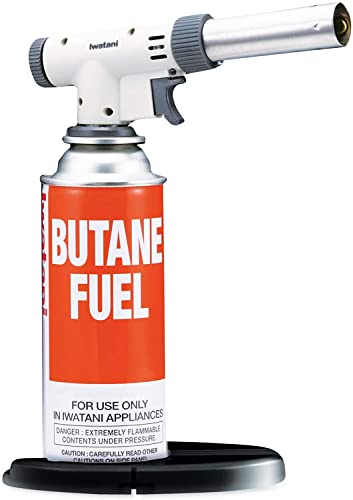
- Butane culinary torch with a 1-year manufacturer warranty (butane not included)
- Adjustable flame size and shape, one-touch piezo ignition and a stabilizing plate
- Listed for crème brûlée, meringue, melting cheese, glazing ham and finishing sous vide steaks
Best for: desserts and finishing work, such as crème brûlée, meringue, melting cheese and browning toppings.
- What stands out: the listing describes an adjustable flame size and shape, one-touch piezo ignition, a stabilizing plate and a 1-year manufacturer warranty.
- Trade-off: the listed 2700°F flame is smaller than a propane gun’s jet, so searing a whole steak takes longer than with propane.
The PRO2 twists onto a butane canister and locks in place, according to the listing (butane not included). Its stand keeps it upright when set down. Its smaller, adjustable flame suits sugar crusts, where too much heat can scorch the top before the sugar melts evenly. Butane torches can flare if tipped too far from upright, so follow the angle and warm-up guidance in the manual.
How to sear sous vide steak with a torch
- Dry the surface. Take the steak out of the bag and pat it very dry with paper towels. Water on the surface has to boil off before browning starts.
- Set up on metal. Put the steak on a wire rack over a sheet pan or on a cast iron pan. Work outdoors, or in a well-ventilated area only if the torch maker allows it, on a clear, non-flammable surface. Never torch over a wooden board or near paper towels, curtains or cooking oil bottles.
- Light, then adjust. Light the torch pointed away from the food, then set a steady blue flame. A yellow, flickering flame is burning less cleanly.
- Keep it moving. Hold the nozzle a few inches from the meat so the tip of the inner blue cone, the hottest part, just reaches the surface. Sweep slowly back and forth rather than holding one spot.
- Watch the fat. Rendered fat can flare. Pause if the drippings flame up and let them settle.
- Flip and finish. Sear the second side and the edges, then turn the torch off, close the valve and let the nozzle cool before you set it down.
A light brush of high smoke point oil helps color develop evenly. Expect a minute or two per side for a typical steak, though the crust you see is the guide, not the clock.
The “torch taste” debate
Some cooks say torching can leave a fuel-like or acrid off-flavor, usually blamed on incomplete combustion when the flame is yellow, too close or too cool. Others say they notice no flavor at all when the flame is fully blue and kept moving. There is no settled answer, and it depends on the torch, fuel, distance and the person tasting. If it concerns you, try a combination sear: most of the crust from a hot pan or grill, with the torch only for edges and touch-ups. Diffuser attachments that spread the flame are also sold for this reason.
Lighting charcoal with a torch
A propane torch lights lump charcoal and briquettes quickly without lighter fluid. Aim the flame at the coals at the bottom of a chimney or at a few spots in a kamado or kettle until they glow, then let airflow do the rest. Kimmzii’s listing estimates about 60 seconds to light charcoal; actual time depends on the charcoal and the wind. Keep the cylinder well away from the fire once it catches, and never use a torch near lighter fluid or on a fire that has lighter fluid on it. For other methods, see the charcoal chimney starter guide and the BBQ fire starter guide. Charcoal, grills and smokers are used outdoors only, never in a garage, porch or any enclosed space.
Propane torch safety
- Location: use propane torches outdoors or in a well-ventilated area as the maker directs, away from anything flammable. Never use one near the grill’s own propane tank, gas line or regulator.
- Fittings: thread the torch on by hand and check the connection with soapy water. Bubbles mean a leak: shut the valve and do not light it. Replace worn seals before use.
- Handling: point the flame away from people, pets and your other hand. Keep children away. Never leave a lit torch unattended, and keep a fire extinguisher nearby, as Bernzomatic manuals advise.
- After use: turn the flame off, close the valve fully, and let the nozzle cool completely before storing it. Bernzomatic manuals say to remove the cylinder from the torch when it is not in use, once the torch is cool.
- Cylinders: store propane cylinders outdoors, upright, out of direct sun and away from heat sources, never in the home, garage, basement or shed, and never under or next to the grill. Do not leave them in a hot car.
Follow the safety instructions that come with your specific torch and cylinder; they take priority over general tips.
Food safety and doneness
A torch only browns the surface. It does not change the temperature at the center in any meaningful way, so check doneness with an instant-read thermometer. USDA FSIS safe minimum internal temperatures are:
- Beef, pork, lamb and veal steaks, chops and roasts: 145°F with a 3-minute rest.
- Ground beef, pork, lamb and veal: 160°F (ground poultry: 165°F).
- Poultry: 165°F.
Many sous vide recipes set the bath below 145°F for a medium-rare result. That is a doneness preference; USDA’s safe minimum for whole beef steaks remains 145°F with a 3-minute rest. Searing the outside of a burger does not make the center safe, so ground meat still needs 160°F throughout.
How to Choose
- Fuel: propane torches are the common choice for steak and charcoal. Butane culinary torches are smaller and better suited to desserts and finishing.
- Flame control: look for a knob that holds a set flame without squeezing the trigger, as the Kimmzii and TAUSOM listings describe. A low, steady setting matters for sugar.
- Ignition and lock: piezo or trigger ignition saves a lighter; a safety lock helps prevent accidental lighting in a drawer.
- Fitting: confirm the torch uses a CGA600 fitting if you plan to run it on standard 1-lb cylinders. Use only maker-approved adapters and hoses for larger tanks.
- Flame shape: a wide tip, like the TS4500’s, covers big cuts evenly; a narrow cone is faster on small spots.
- Grip: a pistol grip keeps your hand off the cylinder. A bare head is simpler but puts your hand closer to the work.
Pair the torch with a vacuum sealer if you cook sous vide often; the vacuum sealer guide covers bagging meat for the bath.
FAQ
Is a propane or butane torch better for searing steak?
Propane torches put out a larger, hotter flame, so they brown a steak faster. Butane culinary torches are gentler and more precise, which suits desserts and small finishing jobs better than full sears.
Can you sear a steak indoors with a propane torch?
Follow the torch maker’s instructions. Outdoors is the safest place to use any propane torch. If the maker permits indoor use, work in a well-ventilated area on a non-flammable surface, away from flammables, and keep propane cylinders stored outdoors.
Does a torch leave a fuel taste on the meat?
Opinions differ. Some cooks report an off-flavor when the flame is yellow or held too close; others notice none with a clean blue flame kept moving. A pan sear with torch touch-ups is a common middle ground.
Will a torch cook the steak further inside?
Very little, if the flame keeps moving. That is the main appeal for sous vide. Check the center with a thermometer; USDA’s safe minimum for steaks is 145°F with a 3-minute rest.
Can one torch do crème brûlée and charcoal?
A propane torch gun with an adjustable knob, such as the Kimmzii or TAUSOM, is listed for both. Turn the flame low for sugar and keep the ramekins on a heat-safe surface.
Bottom line
For sous vide steak plus charcoal, start with a propane torch gun: the Kimmzii lists a knob-set flame with a press-for-max trigger, and the TAUSOM adds MAPP and MAP-Pro compatibility for shop work. Bernzomatic heads suit cooks who already run 1-lb cylinders, with the TS4500’s wide tip aimed at big surfaces. For desserts and finishing, the Iwatani PRO2 butane torch is the precise option. Whichever you choose, check the fittings, work outdoors or with good ventilation as directed, and let the thermometer, not the crust, tell you when the meat is done.
General information only, not professional advice. Details can change or contain errors, so check with the manufacturer or an official source before you rely on them. Use of this site is subject to our Disclaimer and Terms of Service.

