Affiliate disclosure: As an Amazon Associate, PitPrimer earns from qualifying purchases at no additional cost to you. Product availability subject to change.
Fall is when a lot of backyard cooks start grinding their own meat. Hunting season brings venison into the freezer, pork shoulder goes on sale, and a batch of fresh bratwurst or Italian sausage made in October fills the freezer for winter cookouts and game days. Making sausage at home lets you choose the cut, the fat level, the salt and the seasoning, and the equipment needed is simpler and cheaper than most people expect.
This guide covers the three pieces of gear that matter (a grinder, a stuffer and casings), how to choose each one for the amount of sausage you plan to make, and a step-by-step method for fresh sausage cooked on the smoker.
How we picked: we compared current Amazon listings using live price and availability data, manufacturer specifications and owner reviews. We have not cooked with these products ourselves. Our research and recommendation methodology explains exactly how picks are made.
Quick picks
Prices below are as listed at the time of writing (October 2026).
| Pick | Best for | Price | |
|---|---|---|---|
| KitchenAid KSMFGA grinder attachment | Stand-mixer owners making small batches | See current price | Check Price → |
| LEM #8 Countertop Grinder | First dedicated electric grinder | See current price | Check Price → |
| LEM MightyBite #8 Grinder | Regular batches and wild game | See current price | Check Price → |
| LEM 5 lb Sausage Stuffer | Dedicated stuffing for beginners | See current price | Check Price → |
| LEM Natural Hog Casings 32–35mm | Classic brats and Italian links | See current price | Check Price → |
| LEM Smoked Collagen Casings 32mm | No-soak, uniform links | See current price | Check Price → |
| Hi Mountain Bratwurst Kit | Seasoning, cure and casings in one box | See current price | Check Price → |
| The Sausage Maker Pricker | Popping air pockets | See current price | Check Price → |
The rules that make or break homemade sausage
- Keep everything cold. Warm fat smears instead of cutting cleanly, which turns sausage crumbly and greasy. Chill the meat until it is firm at the edges, and put the grinder head, auger, knife and plate in the freezer before you start.
- Get the fat right. Juicy fresh sausage usually lands somewhere around 20 to 30 percent fat. Pork shoulder (Boston butt) is naturally close to that range. Lean meats like venison need added pork fat.
- Weigh your salt. Many sausage makers start around 1.5 to 2 percent salt by meat weight and adjust to taste. A kitchen scale beats measuring spoons every time.
- Mix until tacky. After grinding, mixing the meat with seasoning and a splash of ice-cold water until it turns sticky creates the bind that holds a link together.
Grinders
KitchenAid KSMFGA Food Grinder Attachment: if you already own the mixer
If there is a KitchenAid stand mixer on your counter, this attachment is the cheapest way in. It runs off the mixer’s power hub and comes with fine and coarse grinding plates, a food tray, a pusher and its own storage case. KitchenAid sells a sausage stuffer kit (KSMSSA) separately. It suits batches of a few pounds; for bigger sessions, a dedicated grinder saves time and strain on the mixer.

- Fits any household KitchenAid stand mixer power hub
- Fine and coarse grinding plates, food tray and pusher
- Stores in its own case
- Sausage stuffer kit (KSMSSA) sold separately
LEM #8 Countertop Grinder: the first dedicated grinder
LEM is one of the most established names in home meat processing, and this is its compact entry model. The 575-watt motor processes 2 to 3 pounds per minute through an aluminum head that locks with a quarter turn. You get forward and pulse-reverse buttons for clearing sinew jams, stainless plates and knife, and a stuffing tube and plate so it can double as a stuffer. LEM rates it for occasional home grinding (not for bones) and backs it with a one-year warranty.

- 575 W motor, 2 to 3 lb per minute
- Aluminum head with quarter-turn lock; stainless plates and knife
- Forward and pulse reverse to clear jams
- Includes stuffing tube and plate; 1-year warranty
LEM MightyBite #8: for hunters and regular batches
The step up if you process a deer each fall or make sausage several times a year. LEM rates it at 4 to 5 pounds per minute, with a permanently lubricated motor protected by a circuit breaker, stainless plates and knife, a stomper and three stuffing tubes. The warranty doubles to two years.

- 500 W motor rated for 4 to 5 lb per minute
- Permanently lubricated motor with circuit breaker
- Stainless plates and knife, stomper and three stuffing tubes
- 2-year factory warranty
Why a separate sausage stuffer is worth it
Grinders with stuffing tubes do work, but pushing meat back through the auger works it a second time and can smear the fat. Many sausage makers prefer a piston stuffer: you load the cylinder with already-mixed meat and crank it into the casing in one steady push, which is faster and easier to control, especially with one person.
LEM 5 lb Sausage Stuffer
LEM designed this one for beginners and small batches. It has a removable stainless steel cylinder for easy filling and cleaning, an air-release valve to reduce air pockets, reinforced nylon gears, and three stuffing tubes (11/16, 7/8 and 1 inch outside diameter) that cover snack-stick-to-summer-sausage sizes. It can be bolted down; clamps are not included.

- Removable stainless steel cylinder, 5 lb capacity
- Built-in air release valve
- Three stuffing tubes: 11/16, 7/8 and 1 inch OD
- Reinforced nylon gears; 1-year warranty
Casings: natural or collagen
LEM Natural Hog Casings, 32–35mm
Natural hog casings give the classic snap of a bratwurst or Italian sausage. They come packed in salt, so they need rinsing, flushing and a soak in cold water for 2 to 8 hours before use. Keep them refrigerated; LEM says not to freeze them.

- Edible natural casing with the classic snap
- Sized for brats, Italian sausage and hot dogs
- Rinse, flush and soak 2 to 8 hours before stuffing
- Store refrigerated; do not freeze
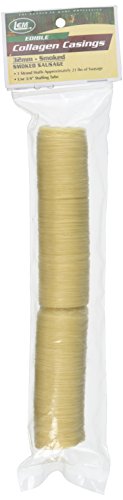
LEM Clear Smoked Collagen Casings, 32mm
Collagen casings skip the prep: no soaking, just slide them onto the stuffing tube. They produce very uniform links and are rated for fresh, cured or smoked sausage, including hanging in a smoker. LEM says one pack stuffs roughly 21 pounds of meat and recommends a stuffing tube of 1/2 inch outside diameter or smaller.
- No soaking required; use straight from the package
- Suitable for fresh, cured or smoked sausage
- Stuffs approximately 21 lb per pack
- LEM recommends a 1/2 inch OD or smaller stuffing tube
Seasoning and small tools
Hi Mountain Bratwurst Kit
If you want your first batch to taste right without building a spice blend from scratch, this kit includes seasoning, cure, natural hog casings and step-by-step directions. It makes up to 24 pounds, and you can season as little as one pound at a time. Because it contains cure, follow the kit’s measurements exactly rather than eyeballing them.

- Seasoning, cure and natural hog casings included
- Makes up to 24 lb; season as little as 1 lb at a time
- Works with pork, beef, venison and other game
The Sausage Maker Sausage Pricker
Air trapped in a link expands on the smoker and can split the casing. This 5.5-inch tool’s three stainless prongs let you pop air pockets right after stuffing.
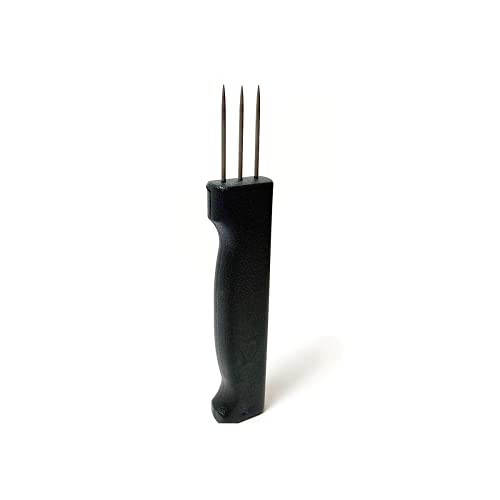
- Three sharp stainless steel prongs, 5.5 inches long
- Removes air pockets in natural, collagen and fibrous casings
Step by step: fresh sausage on the smoker (5 lb batch)
- Cube and chill. Cut about 5 pounds of pork shoulder, fat included, into 1-inch cubes. Spread on a sheet pan and freeze until the edges are firm but not frozen solid. Chill the grinder parts at the same time.
- Grind. Grind through a coarse plate. For a finer, more uniform texture, run half of it through again on the fine plate.
- Season and mix. Add your seasoning (or kit blend) and a small splash of ice water. Mix by hand or with a stand mixer’s paddle until the meat looks sticky and holds together.
- Test a patty. Cook a small piece in a skillet and taste it. Adjust the salt or spice now, before anything goes into a casing.
- Stuff. Slide a prepared casing onto the stuffing tube, leave a few inches of tail, and crank steadily. Fill firmly but not drum-tight, so there is room to twist links. Prick any air pockets, then twist into links, alternating direction each time.
- Dry overnight. Lay the links on a rack in the refrigerator, uncovered, overnight. A dry casing takes smoke better.
- Smoke hot to a safe temperature. Smoke at about 225 to 250°F until the center reaches 160°F for pork or beef sausage, or 165°F for chicken or turkey sausage, per USDA guidance. Time depends on link thickness, so go by the thermometer, not the clock.
- Store it. Refrigerate cooked sausage within 2 hours. Raw fresh sausage keeps only 1 to 2 days in the refrigerator, so freeze what you will not cook right away; a vacuum sealer helps it hold quality in the freezer.
A note on curing salt
Fresh sausage smoked hot and cooked to 160°F does not need curing salt. Low-and-slow smoking below roughly 200°F for hours, cold smoking, and dry-cured sausage are different: the meat spends a long time in the temperature range where bacteria grow, and those styles call for a measured curing salt (such as Cure #1) and a tested recipe. If you use a kit that includes cure, measure exactly as directed. Our cold smoking guide covers the extra precautions in more detail.
Food-handling basics apply throughout: keep raw meat at 40°F or below, work in small batches so nothing sits out, and wash every grinder and stuffer part in hot, soapy water as soon as you finish.
FAQ
Can I use store-bought ground pork instead of grinding my own? Yes, and it is a fine way to try stuffing before buying a grinder. You give up control over the fat level and the coarseness of the grind, and pre-ground meat should be used promptly.
Natural or collagen casings for a beginner? Collagen is easier: no soaking, consistent diameter and fewer blowouts. Natural hog casings take a little practice but give the traditional snap most people associate with a good brat.
Is a stand-mixer grinder attachment good enough? For a few pounds at a time, yes. If you plan to grind a whole deer or 10-plus pounds in a session, a dedicated grinder like the LEM models is faster and avoids working the mixer that hard.
Can I freeze homemade sausage? Yes. Freeze raw links within a day or two of making them, or freeze them after cooking. Wrap tightly or vacuum seal to limit freezer burn.
Do I need curing salt for smoked sausage? Not for fresh sausage smoked hot (225°F and up) and cooked to a safe internal temperature. You do need it for low-temperature, long smokes, cold smoking and dry-cured styles.
Are these prices current? Every price on this page came from Amazon’s product data at the time of writing (October 2026). Prices and stock change often, so confirm both on the listing before you buy.